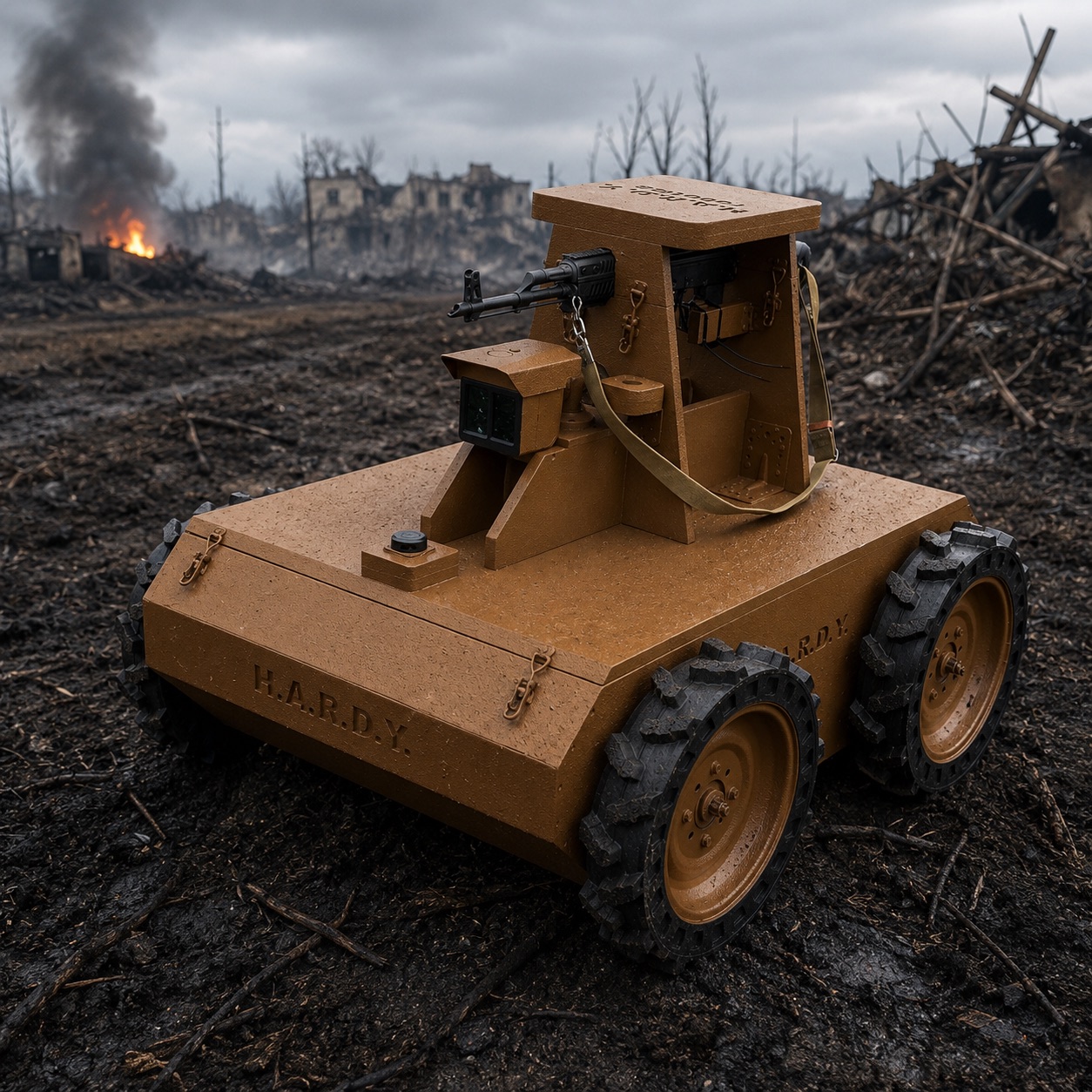
Strike unmanned ground systems are a publicly recognised capability area of the Ukrainian Defence Forces. Ukraine’s Ministry of Defence describes reconnaissance-strike UGVs, remotely operated weapon stations and fire engagement as real procurement and employment categories. The HARDY direction is also public: Defender Media, citing Brave1 Market and an interview with the manufacturer, describes ARGUS, FLEX and VANGUARD in their respective strike roles.
Mission value
ARGUS is positioned for reconnaissance, logistics and remote fire engagement. FLEX is intended for strike missions, breaching and ammunition delivery across difficult terrain. VANGUARD is a high-speed ground robot for one-way assault missions, breaching and ammunition delivery. The platforms are being tested in near-combat conditions, gathering user feedback and preparing for codification.
The HARDY solution
The strike loop is built around human-in-command: sensors create awareness, an authorised operator assesses the situation and decides, the system transmits the command, and the robot performs the physical action. Mechanical integration, power, links, software version, degraded modes and acceptance criteria are controlled for each configuration.
What the user gains
The public and official context is already documented; configuration readiness is demonstrated separately for each product version.
Ukraine MoD: procurement of reconnaissance-strike UGVs and remotely operated weapon stations.
Ukraine MoD: UGV units for fire engagement and other battlefield tasks.
Defender Media: four HARDY UGVs on Brave1 Market and preparation for codification.
Full-loop configuration testing: sensing, operator decision, command, action, event record and controlled outcome.
Next step
Configure the mission
Define the role: remote fire engagement, breaching, ammunition delivery or one-way strike. We can map it to a platform, integration path and test programme.